

Reimagining School Grounds for Earth Day: Why Green Schoolyards Matter Now
Written by National Center on School Infrastructure (NCSI),
At this time of year—as leaves burst on trees, grass pushes up from the snow, and Earth Day is upon us—we here at NCSI cannot help but think about the ways that greening our nation’s school campuses can support positive relationships between the natural environment and student outcomes.
To help understand the opportunities, we spoke with Sharon Gamson Danks, the founder and CEO of Green Schoolyards America, about her decades-long commitment to helping schools and communities increase tree canopy, bring classrooms into the outdoors, and benefit from what research tells us is true: when students have access to verdant spaces, their health and their learning improve.
One Investment, Many Returns
Green schoolyards are more than an environmental intervention. While green schoolyards inarguably have environmental benefits to schools and their surrounding communities, they also improve human and economic outcomes. As Sharon Gamson Danks puts it, “a green schoolyard presents a solution that solves many problems simultaneously in a cost-effective way.”
Research increasingly supports this claim. Both Green Schoolyards America’s own research as well as a 2024 WestEd brief enumerate the myriad ways in which access to green space is associated with improved mental health, higher academic achievement, and greater teacher satisfaction. Districts struggling with disparate challenges—from achievement gaps to staff retention—often find that green schoolyards contribute to progress across all these domains.
What may be less obvious is how those compounding benefits also extend to the economic side of things. Green Schoolyards America has studied the real costs of creating school forests as compared to asphalt lots or artificial turf play spaces. Their findings published in March 2026: planting trees has comparable up-front costs, and usually far lower maintenance costs in the decades that follow. And, unlike asphalt or turf, which degrade over time, “the trees are appreciating, as opposed to depreciating,” Gamson Danks explains.
An analysis by former Federal Reserve economist Rob Grunewald, drawing upon data from a 12-year study of Denver public schools, shows how green infrastructure should be reframed not as an expense, but as a durable asset.
This “multiple bottom lines” framework is essential for policy and funding decisions. Instead of treating education, public health, and climate adaptation as separate silos, green schoolyards demonstrate how integrated investments can yield compounding benefits.
Making the Invisible Visible: Why Schoolyards Matter
Despite myriad benefits, greening America’s schools is not as straightforward as it may seem. Most school facilities, Gamson Danks observes, have been designed around a more traditional educational paradigm: “Systems at both the state level and at the district level are designed to produce indoor education, pavement, and grass” rather than biodiverse outdoor environments that support both ecological and educational goals. Traditional approaches to school facilities “tend to focus almost entirely on buildings and ignore outdoor spaces, even though their grounds might cover hundreds of acres of land. Most school districts do not quantify or track meaningful metrics related to size or quality of their school grounds, making the grounds almost invisible when it is time for the school district administration to set goals and budgets for their facilities plans.”
Green schoolyards counter this invisibility. They function as living systems—places where stormwater flows visibly, habitats support biodiversity, and gardens produce food. In Gamson Danks’s words, the goal is to create “a microcosm of the city that you would like to see,” where ecological processes are not only visible but integrated into daily experience and curriculum. This visibility is not just educational; it is foundational. When children understand their relationship to natural systems, they are better equipped to act as informed stewards in the future.
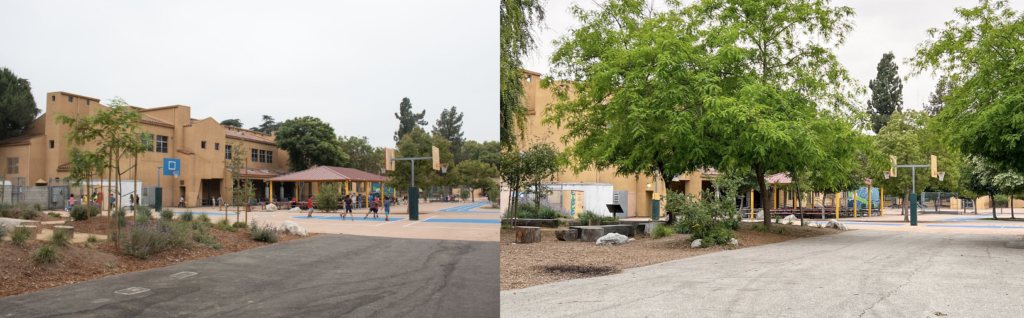
Left image: 2017, soon after a major playground renovation and planting. Right image: 2023, after 6 years of growth. Photo Credit: Green Schoolyards America.
Centering the Student Experience
Gamson Danks says that at the heart of the green schoolyard movement is a simple but transformative question: “Does what we’re doing make life better for children?”
Too often in modern architectural history, the answer has been no. Gamson Danks notes that “adults are at the center of the design. Too frequently, we—adults—design for our own convenience” without taking children’s needs fully into account. The result is school environments that prioritize maintenance efficiency, parking availability, and compliance over students’ lived experiences.
Green schoolyards invert this logic, while remaining practical and code-compliant. They prioritize child-centered design—spaces scaled to children’s needs and which support physical activity, social interaction, and diverse learning styles. These environments include outdoor classrooms, shaded gathering areas, and flexible spaces that support both play and instruction.
Student-centeredness also extends to process. Green schoolyards often involve children in planning and stewardship, fostering agency and civic engagement. As Gamson Danks describes, students can “decide together how public land should be used, and then participate in stewarding and creating that space.”
This shift—from designing for children to designing with and around them—represents a fundamental reorientation of educational infrastructure.
Overcoming Barriers: From Gridlock to Systems Change
Despite clear benefits, widespread adoption of green schoolyards in the U.S. has been slow. Green Schoolyards America identifies a core issue: misaligned policies and institutional structures. Well-intentioned policies that govern school buildings, school grounds, and school boundary lines are often administered by different government entities and, at times, work unintentionally at cross-purposes.
Gamson Danks calls attention to the way building safety regulations are applied to entire campuses. Regulatory frameworks designed for buildings often don’t align well with landscape architecture. For example, planting trees at scale can trigger regulatory oversight originally intended for building construction projects, which creates a disincentive for schools to add green features to their campus footprints. When this happens, Gamson Danks explains, “No one gets anything. Schools can’t plant trees because of the compliance issues.”
In the face of what seems like gridlock, there are pathways forward. Successful strategies include:
- Ongoing research: Children & Nature Network maintains a clearinghouse of research and evidence-based materials to build the evidence base in support of green schoolyards.
- Policy reform: Green Schoolyards America proposes strategies such revisiting funding, building, and administrative policies, including supporting ballot measures to drive change.
- Cross-sector collaborations: Children & Nature Network, a Green Schoolyards America partner, has defined a set of actions aimed at aligning education, forestry, and environmental agencies around shared goals.
- Paradigm shifts: Green Schoolyards America has a library of case-making resources to help local schools recast green schoolyards as critical public infrastructure in their advocacy and community conversations.
A Call to Action for Earth Day
Green schoolyards embody the spirit of Earth Day: local action with global impact. They reconnect children to nature, address climate challenges, and strengthen educational outcomes—all within spaces communities already own.
Yet perhaps their most powerful contribution is cultural. They challenge us to rethink priorities and ask, consistently and rigorously, whether our systems serve the next generation.
As Gamson Danks reminds us, “Children have been handed school campuses designed for what adults find most convenient, and it’s time to shift that and put them back at the center.”