

Form Follows Function: The Role of Education Specifications in Supporting your District’s Education Goals
Written by Mary Morris, AIA, REFP, LEED AP,
In this blog, Mary Morris, AIA, REFP, LEED AP, describes the important role Education Specifications play in educational facility master planning and any design process. Drawing on more than 30 years of experience working on educational facility projects, Mary describes what Education Specifications are and why they bring so many benefits to schools and districts, and provides sage advice on how to develop them to suit local needs.
What are Education Specifications?
Education Specifications, often referred to as “Ed Specs,” are a detailed document that define the physical requirements of the facilities needed to support the educational program. Ed Specs are a uniquely valuable planning tool for your facility planners and architects. They do not just catalog what already exists in your district’s facilities; they provide an opportunity to articulate and communicate how facilities—and the learning environments inside them—contribute to your school district’s educational aspirations.
At their core, Ed Specs describe your district’s—and maybe also your state’s—mission, vision, and curriculum goals. Your district may also have a companion document (sometimes called “Portrait of a Learner”) that further describes what students should know and be able to do upon graduation. Any such resources should serve as jumping-off points for creating detailed Ed Specs that help you draw clear, concrete connections between your educational program and goals and the facilities needed to support them.
Ed Specs also describe the people to be served by school facilities. This includes not only students and teachers, but also classified staff, administrative personnel, parents, and members of the community who also use your district facilities. If you anticipate co-locations or community programming on any of your sites, there may be other representatives to include when creating your Ed Specs, such as preschool program staff, before- and after-school care program operators, or community clinic personnel. Remember, schools that are centers of community are not just for students.
Truly successful Ed Specs are education-driven. Pedagogy evolves—and facilities should too. That means Master Plans and Ed Specs should be forward-looking. You’ll need to identify the various activities your staff and students will engage in. From there, you’ll be able to delineate the facilities that will support staff and students in achieving your district’s educational goals, even if you don’t yet have the funds to pay for those facilities. While you can’t predict the future with absolute certainty, you can:
- Make reasonable assumptions about the need for easy access to power and data to support technology integration.
- Define how you want your campus to be organized for basic functionality.
- Describe the image you want to present to the community.
- Outline your desired balance between supervision, security, and access.
- Document what you think spaces should look and feel like (e.g., size and scale, fit and finish, equipment needed, etc.).
- Determine the level of sustainability and/or climate resiliency you plan to incorporate.

Key elements
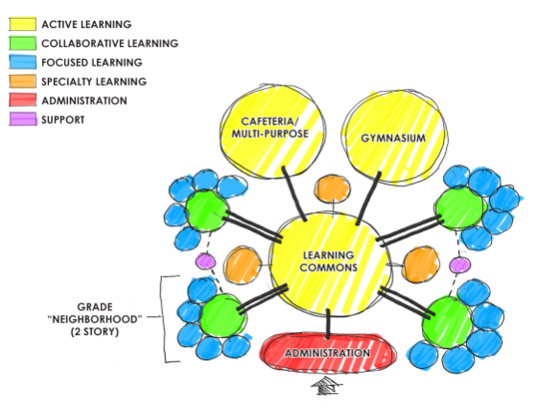
Describing the facilities you need begins at the big-picture level – identifying which major areas should be located near one another to support how the campus functions as a whole. For example:
- Defining the Administration Office as the “front door” of the school, with the capability to serve as the entry control point once the school day has begun. That seems obvious, right? But it’s not the case at many schools that were designed in the 1960s, for example, and now struggle with site security. Schools across the country struggle on this front.
- Locating the high school gym (or gyms) near the locker rooms for ease of use for physical education classes and activities, as well as for visitors who attend games at night and may be unfamiliar with the campus.
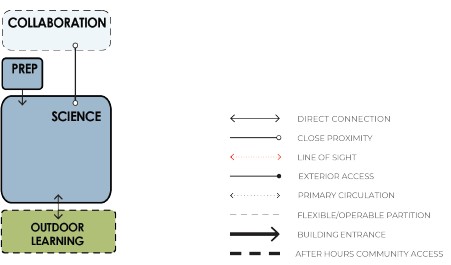
This exercise should generate diagrams that can range from a bird’s-eye view of an entire campus (see Figure 1) to a highly specific illustration of the desired relationships between types of classrooms, including teacher prep and collaboration spaces and outdoor learning areas (see Figure 2).
Ed Specs also specify the fit, finish, furniture, equipment, and technology needed for educational activities and account for your maintenance and custodial capabilities. Some questions to consider include:
- Is the flooring carpet? Hardwood? Resilient flooring?
- Is storage built-in or mobile?
- Is there a sink(s)?
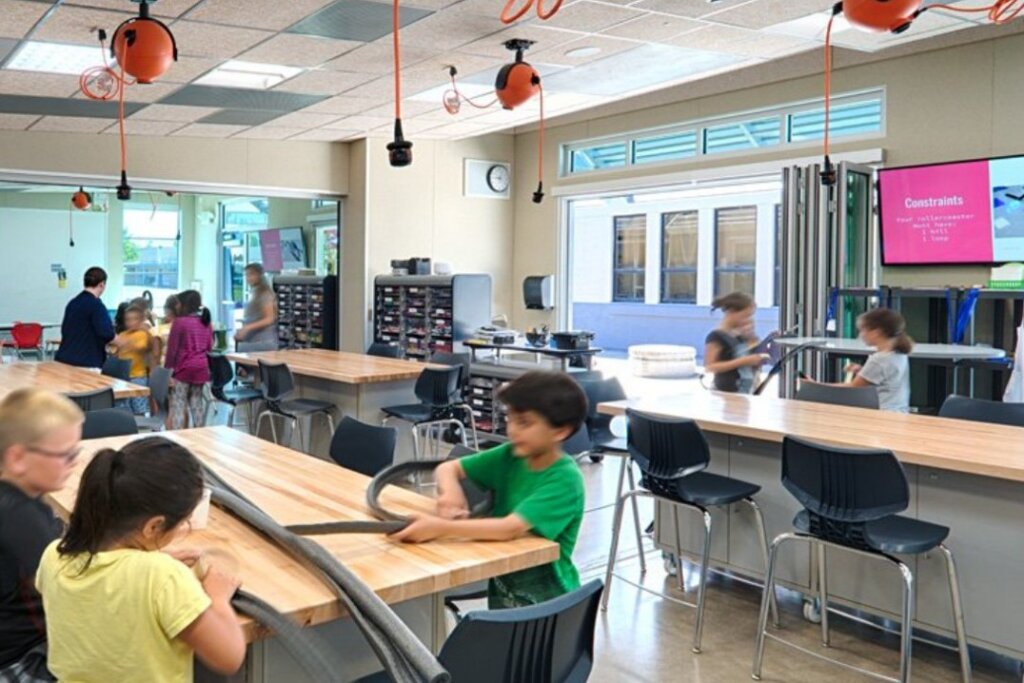
- Are power outlets only at the perimeter, or are there some in the middle of the room, too? (see Figure 3)
It’s important to be as generic as is reasonable when describing such elements. Avoid using specific product names and model numbers to prevent needing to update your Ed Specs whenever your district standards change or a product becomes unavailable. For example:
- Use the term “resilient flooring” instead of VCT (vinyl composite tile), LVT (luxury vinyl tile), or Forbo Marmoleum.
- Call out “HVAC systems tied to the district’s Energy Management System (EMS)” instead of “roof-mounted Trane model number XXXX.”
Why Do You Need Education Specifications?
Ed Specs may be required by your state. In California, for example, they’re required by Title 5 Sections 14001.a and 14030.a of the California Code of Regulations. The California School Board Association’s Board Policy recommends them, and the California Department of Education requires them for districts seeking state funding for new construction or modernization projects. Your state may have similar requirements. But even if they’re not required, there are practical reasons for preparing Ed Specs.
What Are the Benefits of Preparing Education Specifications?
There are many benefits to preparing Ed Specs. Keeping educational needs — and not just facilities fix-it lists — at the forefront of your facilities plans is key. Involving your entire school community in determining what your school facilities should look and feel like before the design process starts creates early buy-in and helps minimize complaints later. Participation in the process creates community “champions” and volunteers for any local campaigns or community outreach needed to support your facilities funding efforts.
Giving your Ed Specs to your architect(s) can streamline the design process, as it can significantly reduce the number of meetings you need to sit through, especially if you’re working with multiple architects on multiple projects.
If done on a district-wide, rather than individual school, basis, Ed Specs also help promote equitable outcomes (rather than equal dollars spent) across your district’s sites. However, this may vary if you have schools with specific programmatic themes. And it may require educating participants to help them understand that equal dollars spent per school site does not necessarily mean equity of facilities, as some of your facilities may be much older or more difficult to modernize than others. It helps minimize the “How come they got XXX at that school, and I didn’t get the same thing at my school” complaints that often arise after the projects are complete.
What are Some Best Practices for Developing Education Specifications?
What I’ve described so far may sound like a big undertaking, but the good news is that you don’t have to do it alone. The best Ed Specs result from a process that engages your entire school community. That’s why broad community engagement, which is described further below, is important.
A well-rounded group of participants should be engaged in the process to help ensure the plan covers all bases and has broad buy-in when you take steps to fund and implement it.
- You’ll need the support of your Superintendent and cabinet to help you persuade others to see the value of Ed Specs, take the effort seriously, and dedicate their time to the process.
- Teachers and classified staff (such as custodial and food service leads and administrative office managers) should also be involved because their daily lived experience can provide insights into what works and what doesn’t on your campuses. They can provide critical insights whether you are planning for new schools or upgrading existing facilities.
- District-level staff, such as your maintenance & operations leads, the Assistant Superintendent for Curriculum, and, if you have them, Teachers on Special Assignment (TOSAs), can offer additional perspectives on factors that one-time visitors might not notice.
- Parents, neighbors, a board member or two, community leaders, and potential employers in your community should all be considered for their valuable insights into the process.
- Including students is also strongly recommended; they can offer unique insights into how spaces are used and provide creative and unexpected ideas for improvements. Of course, methods for incorporating student voices into your Ed Spec process should vary by grade level to ensure they are age-appropriate and provide meaningful input.
Once you’ve got a diverse committee, employ creative strategies to help them think beyond the status quo and plan for the future. For example, have your Ed Spec committee members visit other schools to get inspired. Folks often don’t know what to ask for if they have only ever seen a limited number of schools. They may have also been told “there’s no money for that,” which might lead them to set their sights low or focus only on the fix-it list.
If it’s appropriate for the grade levels you serve, ask your committee members to consider future employment opportunities that may be specific to your locale (farming, manufacturing, and healthcare are a few examples) and the skills students will need to thrive in those occupations. This may be less relevant at the elementary grade levels, but it should certainly be considered at the high school level.
When Should You Create Education Specifications?
Ideally, you would develop Ed Specs before completing your Facilities Condition Assessment (FCA) so the FCA can assess both educational and building maintenance needs. I’ve seen many FCAs that focus on the physical conditions of existing buildings, with little attention to educational goals or functional adequacy. Doing Ed Specs early and updating them often will help you avoid missed opportunities and serve you well in the long run.
If you establish Ed Specs after your site- or district-wide Master Plan is complete, you often end up having to re-plan/re-design the Master Plan and, worst of all, re-budget when specific project design begins, as the functional issues that could have been identified in the Ed Specs come to the fore. Many master plan budgets based solely on the FCA have turned into much larger, much more expensive plans once the design of individual projects started and the site’s educational and functional needs were finally factored in. That is a rough time to realize you need to add significant scope and budget to your FMP.
In short, doing your Ed Specs early and ensuring they are updated often will save time, money, and lots of hassle.
Think Outside Your Box(es)
Finally, be sure to structure a process that encourages participants to think creatively and “outside the box” of what already exists in your district facilities. Designing and building more of what you already might feel easier and more comfortable, while designing and building differently may feel risky because you don’t get to do it very often, and you will have to live with the results for a long time. New also means managing and maintaining things differently. But if you only ever build more of what you already have, you’ll only ever get what you’ve already got, and that is not a recipe for facilities that support future-focused education.
If this is your first round of building improvements/upgrades in many years, you may wind up needing to spend most of your funds to meet the “safe, warm, and dry” standard, but opportunities abound for improvements to educational assets even within those projects, and you’re looking to inspire people about what you can accomplish. The Ed Spec process and the document produced are a golden opportunity to translate your educational vision into the built form of facilities; use them thoughtfully and wisely!
Example Education Specifications from around the Country
Kennedy High School Modernization Project, Education Specifications (2024). West Contra Costa Unified School District (Alameda County, California). Provides an example of Ed Specs created for a large, comprehensive public high school modernization project focused on the school’s unique curriculum.
The Northwest School, Education Specifications (2020). Seattle, Washington. Prepared for a private middle and high school campus, this example illustrates a highly detailed, robust assessment of existing facilities and the development of Ed Specs, incorporating insights from faculty and students.
Boston Public Schools, Educational and Programming Standards (2023). Boston, Massachusetts. This PreK-6 & 7-12 School Design Study provides a detailed example of development standards for a large urban district with a wide variety of building and campus types.
Mary Morris, AIA, REFP, LEED AP has more than 30 years of experience working on educational projects for large architecture and planning firms. Currently, Mary provides consulting services to assist school districts, architects, and contractors achieve greater satisfaction and success with their completed facilities projects by getting them off on the right foot. Throughout her career, she has worked on nearly all aspects of educational facility planning and design, including developing education specifications and conducting facilities assessments, facilitating site committee and community engagement processes, leading master planning processes, conducting peer review of design and construction documents, and serving as an owner’s architect representative for Design-Build projects.