Performance Contracting: A Partnership to Improve Facilities and Unlock Funding Opportunities
Written by UndauntedK12,
School districts across the country face a common set of challenges: aging building portfolios with millions (or billions) in deferred maintenance; the intensifying pressures of extreme weather and a changing climate on school infrastructure; and limited human capacity and capital budgets for implementing needed facilities upgrades.
Performance contracting can help districts contend with these realities. Energy savings performance contracting (ESPC or “performance contracting”) is a contractual partnership between a building owner and an Energy Services Company (ESCO). The ESCO identifies a collection of energy-saving improvements, devises a financial plan that incorporates all available funding, and implements the improvements. ESCOs share in the value they create for owners by making buildings more efficient.
Schools have long had the opportunity to leverage performance contracting. But the urgency of addressing the backlog of deferred maintenance, along with the opportunity to tap the expertise of ESCOs to achieve facilities improvements that are eligible for federal energy tax credits, has made this a particularly timely moment for school districts to explore performance contracting.
Salt Lake City School District (Utah) partnered with McKinstry, an energy services company, on an energy savings performance contract. The first phase of this work included installing over 2,500 solar panels across six schools. The district claimed federal energy tax credits for the solar projects andreceived a $1,222,653 check from the IRS. In combination with energy efficiency measures, these solar panels are projected to save the district over $23 million the next 20 years. (Salt Lake City Schools, Utah. Courtesy of Building Power Resource Center.)
Leveraging Expertise to Drive Energy-Saving Projects
Inefficient buildings waste energy and money. The central idea of performance contracting is that building improvements can generate savings that can repay financing for the upgrades.
Districts start by competitively selecting an ESCO. The selected ESCO performs an assessment of the district’s facilities and proposes a set of improvements along with an accompanying financial model that incorporates projected energy savings, expected incentives, and any funds to be contributed by the district. The district and the ESCO negotiate the performance contract which may include performance guarantees. The ESCO may assist the district in securing third-party financing such as a tax-exempt municipal lease. The ESCO then partners with the district to select equipment and subcontractors, and implement the improvements. Districts and ESCOs work in partnership over time and typically across multiple interventions (e.g. HVAC controls, lighting, solar) to drive building efficiency and ultimately savings.
This contracting structure can help schools under financial constraints create a budget from “avoided costs” and start benefiting from energy-efficient technologies, such as ground-source heat pumps, that might otherwise be out of reach.
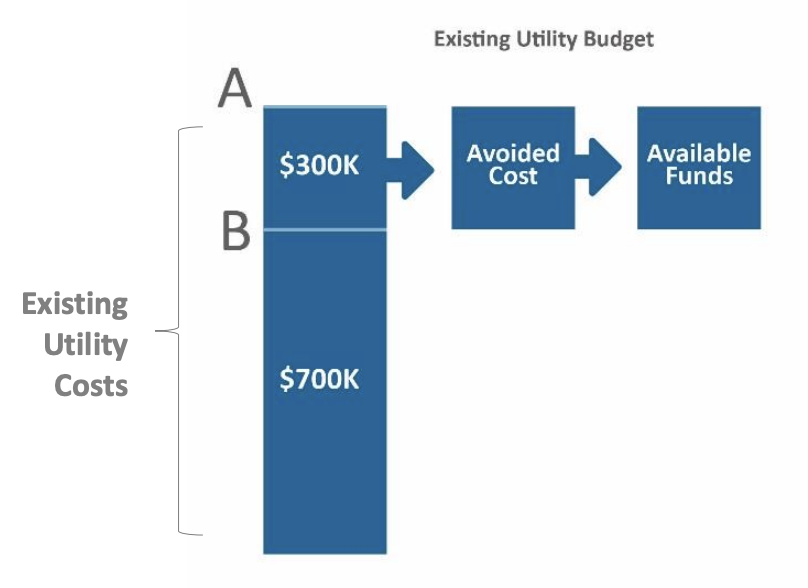
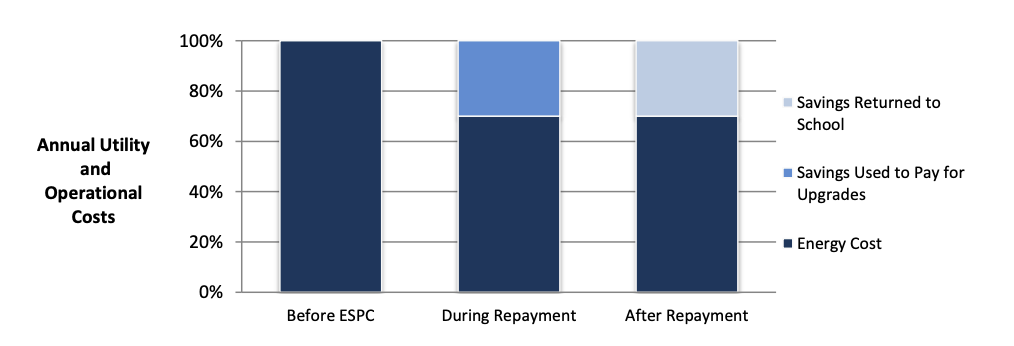
For example, consider a district that spends $1 million annually on utility costs. An ESCO identifies improvements that are projected to reduce utility costs by $300,000 per year. These savings are “avoided costs” that can finance the project (see Figure 1). The costs associated with developing the project plan and compensating the ESCO for their services are included in the financial model. Once the project is paid off, the savings from the improvements accrue to the school district’s operating budget (see Figure 2).
Successfully implementing an energy-savings project requires competencies that many school districts don’t have. And traditional procurement pathways would require schools to engage in multiple contracts to secure those services. ESCOs can design energy solutions, identify and help secure available funding, implement the work, measure outcomes, and guarantee performance with one contract and with one point of accountability.
Unlocking Energy Tax Credits with Performance Contracting
Performance contracting can help schools make the most of these widely available federal incentives.
Federal energy tax credits are uncapped and non-competitive sources of funding for qualifying clean energy projects. As tax-exempt entities, schools can claim these tax credits through a funding mechanism called Elective Pay and receive a cash reimbursement anywhere between 6% to 50% of the eligible energy project costs. Schools across the country have already claimed millions in credits for installing cost-effective technologies, such as ground-source heat pumps. Federal tax credits are available for ground-source heat pump projects that start construction by December 31, 2034.
For districts that would not otherwise have the capacity to plan and implement these projects, the partnership with an ESCO allows schools to take advantage of substantial federal tax credits, lowering the costs to local taxpayers. In some cases, ESCOs are helping school districts plan multiple phases of work that envision reinvesting the cash reimbursements generated by energy tax credits to fund additional facility improvements.
Hart County School District (Kentucky) pursued performance contracting with CMTA and upgraded a boiler system with an energy-saving ground–source heat pump. By then claiming the tax credit for ground-source heat pumps through Elective Pay, the district received a $793,079 cash reimbursement from the IRS. (Hart County School District, Kentucky. Courtesy of CMTA.)
Case Study: Springfield Public Schools, Missouri
Springfield Public Schools (SPS) recognized the need to modernize outdated HVAC systems in several of their school buildings but faced limited funding. Seeking support on project design, funding, and implementation, the district released a Request for Proposals in July 2023. In December 2023, the district chose to partner with Veregy, an energy services company that has supported hundreds of K-12 projects nationwide.
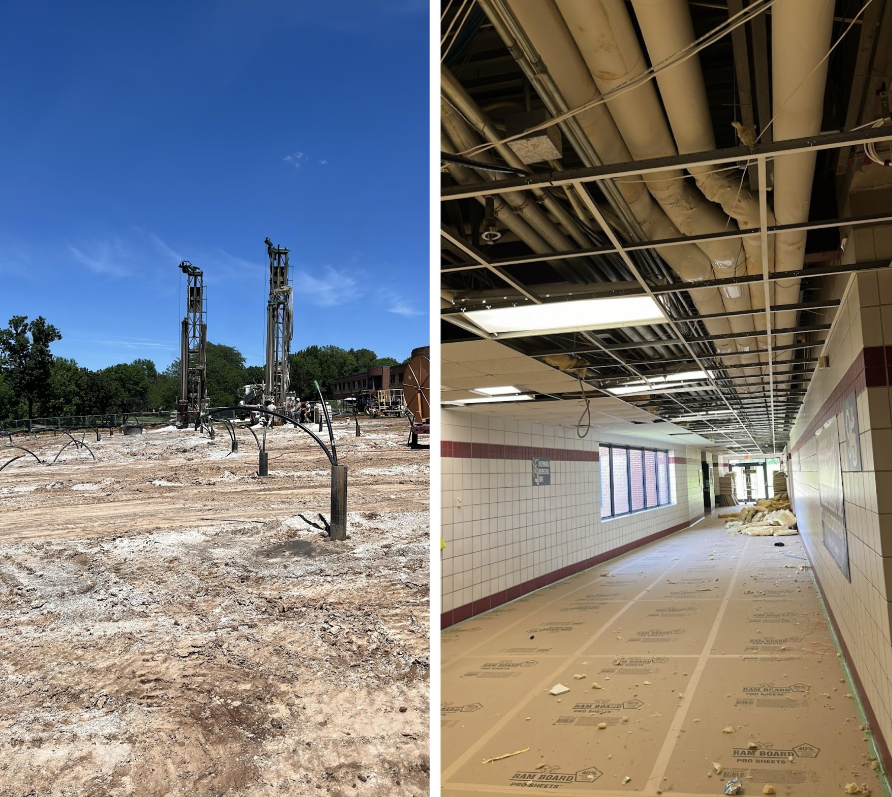
Springfield Public Schools (Missouri) utilized performance contracting with Veregy to advance facility upgrades, including installing ground-source heat pumps. (Springfield Public Schools, Missouri. Courtesy of Veregy.)
Veregy identified that ground-source heat pumps would be the most cost-effective HVAC solution in part because of the opportunity to leverage an estimated $4M in federal energy tax credits.
The project scope was extensive and the timeline was short. Construction work included drilling 170 geothermal wells, installing 164 water-source heat pumps, and replacing 40,000 square feet of acoustical ceilings. The drilling of the wellfields began in February 2024. Once the students were released for summer break, Veregy began the installation work inside the buildings. Veregy was able to fully complete the HVAC replacements in three different school buildings by August 2024, in time for the start of a new school year.
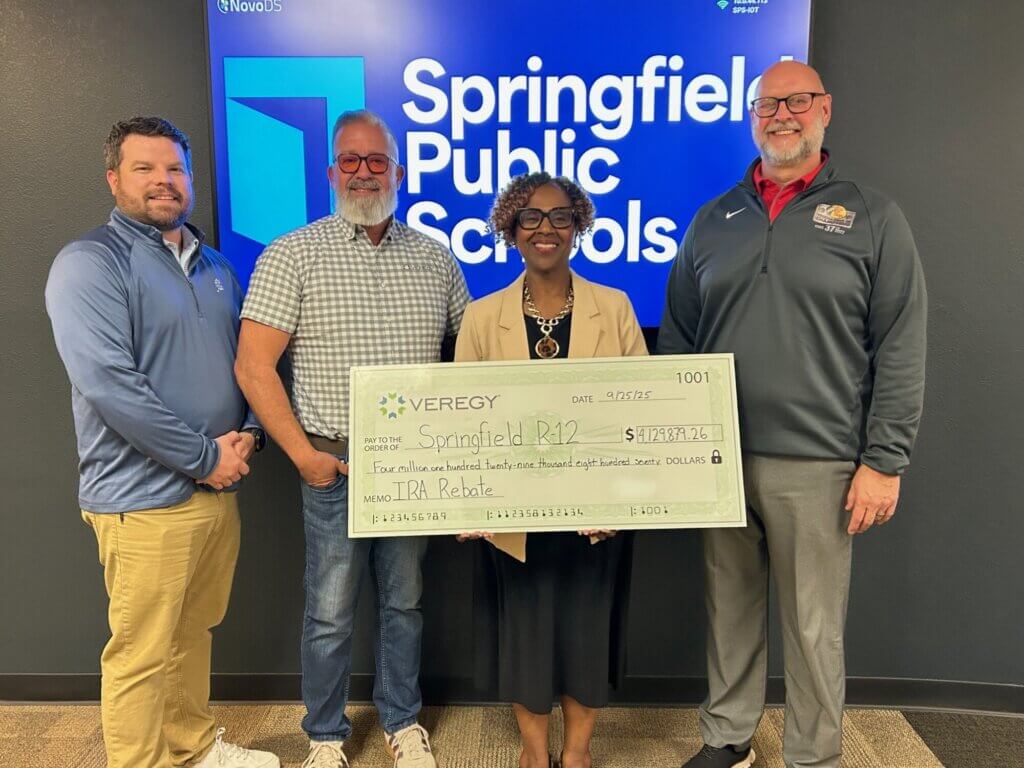
Veregy assisted the district in compiling the information needed to file with the IRS for the energy tax credit and identified a tax professional partner. After submitting the filing to the IRS in July 2025, the district received a check in September 2025, for $4.1 million for the installation of three ground-source heat pumps and is planning future improvements with these funds.
District leaders at Springfield Public Schools (Missouri) and Veregy celebrate the $4.1 million reimbursement for installing ground-source heat pumps with a ceremonial check. (Springfield Public Schools, Missouri. Courtesy of Veregy.)
“By partnering with Veregy, SPS is not only able to reduce energy and operating costs but improve sustainability, which results in better stewardship of taxpayer resources and enhanced learning and working environments for students and staff,” said Dr. Travis Shaw, Deputy Superintendent of Operations at SPS.
This project at Springfield Public Schools demonstrates the benefits of using performance contracting: timely implementation of cost-effective facility upgrades that leverage federal dollars, improve learning environments, and advance district sustainability goals.
Learn More
School leaders who want to learn more about performance contracting and energy service companies can start with the following resources:
Watch the Build America’s School Infrastructure Coalition’s (BASIC) webinar to hear about the work in Springfield, Missouri and Warren County, Kentucky with two different ESCOs that delivered substantial building improvements and unlocked millions in energy tax credits.
School leaders can dive into more examples of schools that have successfully used the approach to advance facility improvements. Explore UndauntedK12’s blog posts about schools that have used performance contracting to successfully implement energy projects and receive checks for tax credits.
For more information regarding federal energy tax credits, visit UndauntedK12’s Energy Tax Credits for Schools Hub, which provides up-to-date information, resources, and more district examples. All schools should consider whether they have an opportunity to incorporate ground-source heat pumps and earn valuable federal energy tax credits.
This document is a primer covering the basics and best practices for establishing Energy Savings Performance Contracting (ESPC) in K-12 school districts.
The Energy Savings Performance Contracting (ESPC) Toolkit is a collection of resources that includes best practices and innovative approaches that states, cities, and K-12 schools have used to successfully establish and implement energy savings performance contracting (ESPC).