Explore updates from NCSI on our blog, catch up on the latest news with our facilities news tracker, browse upcoming events, and find information on funding, recognition, and training opportunities.
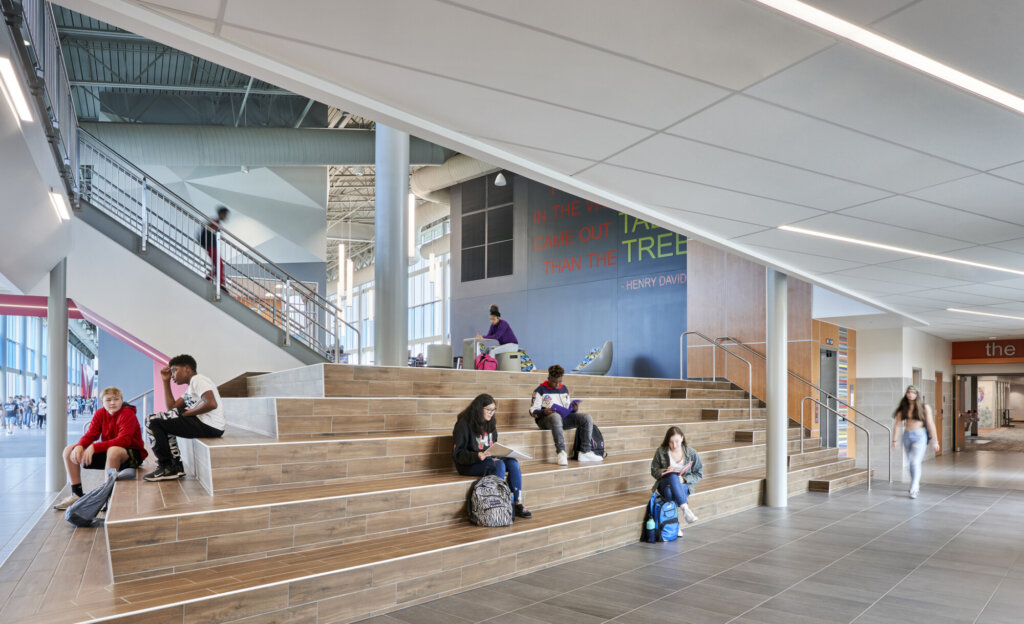
Capps Middle School, Warr Acres, OK; Photo Credit: Michael Robinson and DLR Group
Child Trends, a NCSI Consortium partner, promotes the well-being of children and youth through applied research that informs public policy. In this post, they highlight the need for more attention on the ways that school facility conditions impact teachers and staff.
Matthew Palmer, Director of the School and Community Aligned Master Planning project at NC State University, makes the case that better alignment across transportation, facilities, and regional planning efforts improves outcomes for students.
A Vermont school has spent millions of dollars toward eliminating toxic PCB contamination, but the problem hasn’t gone away. The solution in Burlington was a new school building that opened this year and that may be an option for North Country Union High School, but the big question remains: Who would pay for it? School officials have worked to keep PCBs out of the air students are breathing, but the fixes can only go so far and they are turning to the state for help. North Country High School Principal Chris Young said the district added air purifiers in classrooms after PCB contamination was discovered at the school in 2024. “As we took more and more tests, we realized the scores and the results coming back were worse and worse, especially when we were testing in the summer months when the PCBs seemed to be at the highest levels,” Young said.
With 60% of its $75 million solar energy system down, Mount Diablo Unified School District is left with questions about maintenance, repairs and financial losses. For years, the district has operated what it says is one of the nation’s largest solar energy systems for a kindergarten-12th grade school district. Installed in 2010 using bond money, the system has generated about 11 megawatts of energy annually and saved the district about $17 million in general fund dollars. A recent inspection by SunUp Solar Tech Service, a solar operation and maintenance company, found that 43 of the district’s 77 inverters are offline. Inverters are key elements of a solar energy system that take direct current electricity and turn it into alternating current electricity, which is the type of energy used by the power grid, according to the U.S. Department of Energy. Without the 43 inverters, the district is losing out on about 7,860 kilowatts of electricity, or nearly eight of the 11 megawatts promised in the past.
Guam’s public schools are facing an estimated $427 million in repairs and improvements, a backlog that lawmakers say underscores problems that go far beyond getting classrooms ready for another school year. The figure emerged during a legislative oversight hearing on the Guam Department of Education, where lawmakers pressed department officials on aging facilities, sanitation inspections, maintenance staffing and whether schools are getting the long-term attention they need. GDOE’s Facilities and Maintenance Division has about 72 employees and remains largely reactive, responding to problems as they arise rather than having enough personnel to perform preventive maintenance.
The Boulder Valley School District (BVSD) Board of Education met on August 25 with one item on the agenda. That one topic of discussion was the Resilient Schools Proposal. With declining enrollment for some years and more projected in the future, BVSD is looking to make changes. The board made no decisions at this meeting. The meeting was planned to hear the proposal developed by staff and for the board to ask questions. Superintendent Dr. Rob Anderson spoke first, saying that he is proud of the process they have developed. “We listened first to our community, and in the world of school closures and consolidations unfortunately that is unique.” Assistant Superintendent of Operational Services Rob Price led the presentation on the proposal. He said, “This is not about failing schools. It is about adjusting our systems to better serve our students.”
Within more than $313 million of statewide school debt that went up for sale Thursday, Rock Hill school officials have a plan they believe will save taxpayers money and improve aging facilities. The Rock Hill school board approved a plan Tuesday to borrow nearly $33 million as part of a South Carolina Association of Governmental Organizations bond package. That program allows school districts to borrow up to 8% of their total assessed property value without needing a bond referendum. While that debt typically goes to capital and maintenance needs, the Rock Hill district intends to use it to pay off long-term debt. Coupled with a new maintenance reserve fund policy, district CFO Kevin Madden sees a more nimble and less costly way to fund school capital needs moving forward.
Join the American Lung Association for a virtual webinar to learn about preventing radon-related lung cancer in your community through developing and implementing radon risk reduction requirements for school buildings.
Lawrence Berkeley National Laboratory (LBNL) and the National Center on School Infrastructure (NCSI)
Join this webinar, co-hosted by Lawrence Berkeley National Laboratory and the National Center on School Infrastructure, to learn how Energy Savings Performance Contracting can help schools and other public facilities improve infrastructure, reduce energy costs, and achieve long-term operational savings.
American Planning Association Public Schools and Communities Division
Join the American Planning Association’s Public Schools and Communities Division for a Lunch and Learn on the use of open enrollment as a student assignment strategy.
The 2027 Magna Awards will recognize school districts leading the way in healthy schools and strong indoor air quality practices, with $5,000 grand prizes for winning districts. Applications are due October 31, 2026.
The Clean Air School Challenge (CASC) is an engagement, recognition, training and technical assistance program that will empower K-12 schools across the country to address indoor air quality.
Businesses and tax-exempt organizations, including schools, can claim the Investment Tax Credit (Sec 48) for ground-source heat pump (aka geothermal heat pump) projects.