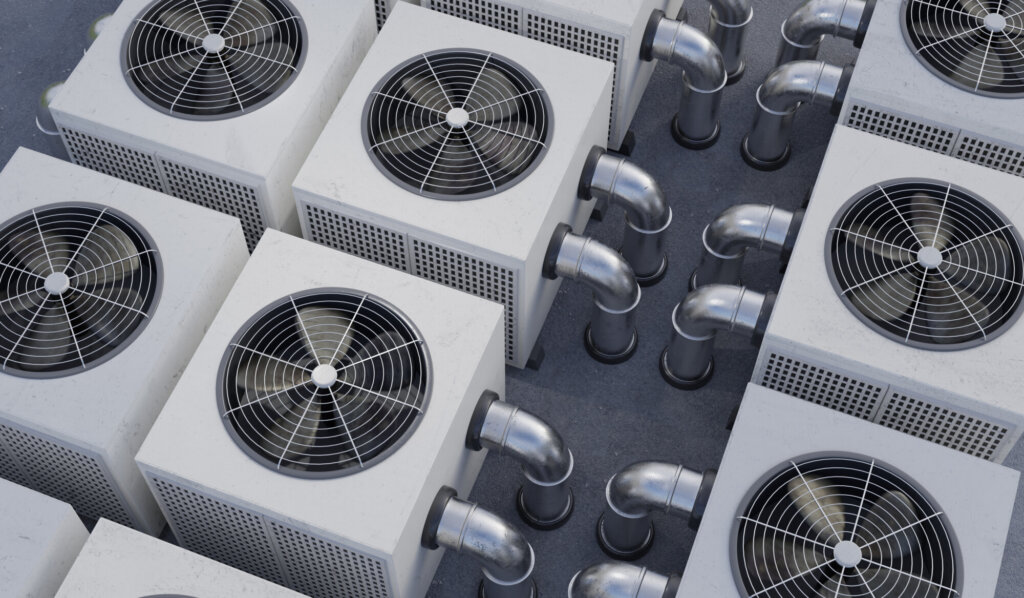
How school buildings are heated and cooled directly affects student health, learning, building operations, and a district’s budget. This page highlights resources from NCSI’s library that shed light on the impact of classroom temperature on student outcomes, the scale and cost of modernizing HVAC (heating, ventilation, and air conditioning) systems, funding pathways available to districts seeking system upgrades, and what else is needed to help schools maintain safe, comfortable classroom temperatures.

The HVAC Change Lab. NCSI, the Center for Green Schools at the U.S. Green Building Council, and the New Buildings Institute have launched the HVAC Change Lab, a national partnership helping under-resourced districts upgrade aging heating, ventilation, and air conditioning systems through technical assistance and a growing network of partners. Learn more.

What the research says about how temperature affects student outcomes

Classroom temperature is one of the most basic conditions for learning, and one of the most unevenly met; aging HVAC systems leave many schools unable to maintain comfortable, healthy temperatures. And when rooms are too hot or too cold, students lose focus, test scores fall, and in extreme cases, schools close. 

The effects of lost learning time are cumulative: sustained heat over a school year does more damage than isolated hot days, a pattern documented both in the U.S. and internationally in peer-reviewed research. Managing temperature is not about comfort for its own sake — it is a measurable lever for attendance, behavior, and achievement.

Robust data collection is critical for managing temperature. Recent research using continuous classroom monitoring shows how widely indoor temperatures can vary even within a single school building. The analysis emphasizes the importance of continuous temperature monitoring in all classrooms rather than isolated point-in-time readings.

A landmark analysis of 10 million U.S. students found that, without air conditioning, each 1°F increase in average school-year temperature reduces how much students learn that year by about 1% — and that air conditioning almost entirely offsets the effect.

The scale and cost of the HVAC gap

The HVAC needs in schools across the U.S. are large and growing. According to the U.S. Government Accountability Office, roughly 41% of school districts need to update or replace HVAC systems in at least half of their schools — about 36,000 buildings nationwide. The growing frequency of high-heat days is compounding the problem, driving cooling demand into regions that never planned for it while aging systems strain to keep up.

The costs are concentrated where capacity is thinnest. In its 2021 report Hotter Days, Higher Costs, the Center for Climate Integrity estimates more than $40 billion is needed to install or upgrade cooling in over 13,700 schools that didn’t need it in 1970, plus roughly $1.5 billion a year to operate cooling systems — with lower-income communities facing the steepest barriers to both heat relief and funding.

These resources show the scale of the challenge:

Choosing and funding modern systems

Districts stall on HVAC modernization for a few reasons: modernization requires significant capital, and the path for upgrading systems requires alignment across a wide range of stakeholders, including administrators, engineers, installers, and operators. Several blog posts and resources in NCSI’s library explain options for making upgrades accessible and describe the additional tools and resources needed to help support decision-making and action.

Modern systems: heat pumps and electrification 

All-electric heat pumps move heat rather than burning fuel, delivering both heating and cooling from one system while eliminating on-site combustion, improving air quality, and — especially for ground-source systems — lowering long-term operating costs. HVAC Choices for Student Health and Learning provides an orientation for non-technical decision-makers: it covers the research linking HVAC to health and learning, the major technology options, and a framework for weighing life-cycle costs against available funding.

Energy tax credits via Elective Pay 

Federal energy tax credits are available for reimbursing public schools for a substantial share of clean-energy upgrades, including ground-source heat pumps, through a mechanism called Elective Pay (also known as direct pay). UndauntedK12’s Ground-Source Heat Pumps: A Modern HVAC Choice is a one-page overview to share with stakeholders; Ground-Source Heat Pumps: Full Speed Ahead explains the technology and the roughly 30% (and up to 50%) credit opportunity; the Guide to Maximizing Energy Tax Credits walks project teams from planning through filing; and Lead a Successful Elective Pay Process lays out the filing steps. The Resource Spotlight on ground-source heat pumps pulls these threads together with district case studies.

Energy savings performance contracting (ESPC) 

Tax credits aren’t the only route. Under performance contracting, a district partners with an energy services company (ESCO) that identifies, finances, and implements efficiency improvements, with the project paid back over time from the “avoided” utility costs generated by the upgrades. Once the contract is paid off, those savings flow into the district’s operating budget. The U.S. Department of Energy’s Performance-Based Contracting: A Primer for K-12 Schools and its stage-by-stage ESPC Toolkit outline best practices and tips for using this approach. For a real-world walk-through, the feature Performance Contracting: A Partnership to Improve Facilities and Unlock Funding Opportunities shows how one district combined an ESCO partnership with federal tax credits.

Additional tools and resources are needed. 

Early findings from the HVAC Change Lab point to several common barriers that districts face in upgrading HVAC systems: 

  • Districts have difficulty making the financial case for high-efficiency systems during the budgeting and planning phase
  • Institutional habits pull projects back toward familiar, lower-performing solutions 
  • A lack of technical standards and specifications get in the way of translating goals into consistent project requirements
  • Project delivery failures in both installation and handoff erode the value of even well-designed projects. 

Taken together, the findings point to gaps in shared field resources — tools, standards, and templates — that any district could draw on to advance HVAC modernization.

In making HVAC equipment decisions, districts benefit from evaluating life-cycle costs, preparing for both chronic and acute conditions, and knowing where the funding levers are. Rather than choosing the cheapest system to install, districts can use a life-cycle cost analysis that accounts for installation, operation, and maintenance over the system’s full life; the HVAC Choices guide provides a framework.


Ventilation, passive cooling, and air quality

Not every improvement requires a full system replacement. Passive measures like window shading, natural ventilation, and building-envelope improvements, can meaningfully reduce overheating, as shown in Avoiding Overheating in Existing School Buildings. Ventilation and filtration upgrades address temperature comfort and indoor air quality at once: Ventilation in Schools and Childcare Programs, from NIOSH and the CDC, offers practical guidance on maximizing outdoor air, upgrading to MERV-13 filters, adding portable HEPA units, and maintaining exhaust systems.

Heating, cooling, and air quality are tightly linked; explore Indoor Air Quality resources for materials on ventilation and filtration.

Planning for extreme heat and reliable winter heating

More frequent high-heat days are pushing classroom temperatures past safe thresholds and driving districts to take action. UCLA’s Heat-Resilient Schools Resource Kit offers policy briefs, fact sheets, and infographics on reducing heat burden and addressing heat inequities, and the School Board Member Climate Action Toolkit helps board members lead on HVAC modernization. Heating reliability deserves the same foresight: districts that prepare boilers, pumps, and controls before the first deep freeze avoid the cold classrooms and emergency repairs that interrupt learning when winter arrives.

For the broader hazard picture — wildfire smoke, flooding, and emergency planning — explore Extreme Weather and Natural Hazards resources. 

Suggest Resources

Do you have a suggestion for a resource that should be included in our library?